The Interior Castle
Summary by Chapter
By Saint Teresa of Avila
Introduction
The Interior Castle is one of the greatest works of Catholic spirituality. In this book, Saint Teresa of Avila describes the soul as a magnificent crystal containing many rooms or “mansions.” God Himself dwells in the innermost chamber. The spiritual life is the journey inward through these mansions toward perfect union with God.
Entry into the castle begins through prayer and self-knowledge. As the soul grows in virtue and detachment from sin, it progresses deeper into the castle. Each mansion represents a higher stage of spiritual life, moving from conversion to mystical union.
"I began to think of the soul as if it were a castle made of a single diamond or of very clear crystal, in which there are many rooms."
- Saint Teresa of Avila
The Mansions of the Interior Castle
First Mansions - Awakening to the Spiritual Life (2 Chapters)
Souls in the first mansions have begun the spiritual life but remain near the outer walls of the castle. They are still surrounded by worldly distractions and temptations. The key lesson here is the importance of self-knowledge and humility. Without recognizing one's own weakness and sinfulness, it is impossible to advance deeper toward God.
- "Self-knowledge is so important that I should not like you to neglect it, even if you were raised to the heavens."
- "It is a great thing to have advanced thus far, even though we should go no farther."
- "The door by which we must enter this castle is prayer and meditation."
- "The soul that does not strive to avoid the occasions of sin is in great danger."
- "We must not be surprised if we are sometimes in darkness, for we are still so near the outer court."
- "Humility is the ointment for our wounds."
Key Insight: The first step is to enter the castle - begin to pray and seek God, even if imperfectly.
Summary: The soul awakens to the reality of God and the spiritual journey, but is still attached to sin and the world. Progress requires honesty, humility, and a desire for conversion.
Second Mansions - The Beginning of Spiritual Combat (1 Chapter)
The soul now hears God's call more clearly and begins to persevere in prayer. However, the struggle against temptation intensifies. Growth requires regular prayer, spiritual reading, good companions, and perseverance despite failures. This stage is marked by spiritual warfare as the soul attempts to leave worldliness behind.
- "The important thing is not to think much, but to love much; and so do that which best stirs you to love."
- "Let us strive to make progress, for the Lord will give us help."
- "The devil sets many snares here, and it is necessary to walk with caution."
- "God calls us ceaselessly, but we do not always listen."
- "Perseverance is the most important thing; with it, we shall reach our goal."
- "The soul must not be discouraged by falls, but rise again and trust in God's mercy."
Key Insight: Progress depends on perseverance in prayer and trust in God's mercy, not on one's own strength.
Summary: The soul is no longer content with mediocrity and begins to fight for virtue. Temptations may increase, but so does the desire for God.
Third Mansions - A Virtuous but Imperfect Life (2 Chapters)
Souls here live upright Christian lives. They avoid serious sin, practice virtue, and fulfill religious duties faithfully. Yet a danger appears: spiritual complacency. These souls may rely too much on their own strength and discipline rather than on God's grace. God often allows dryness in prayer at this stage in order to teach humility and deeper trust.
- "The Lord leaves them in dryness so they may know that they can do nothing without Him."
- "We must walk with caution and humility, for we are not yet strong enough to face great trials."
- "The greatest perfection does not consist in interior delights, but in the increase of love."
- "Let us not trust in ourselves, but place all our confidence in God."
- "The soul must not be content with avoiding sin, but must strive for greater virtue."
- "God sometimes withholds spiritual sweetness to test our love and perseverance."
Key Insight: True virtue is rooted in humility and dependence on God, not self-reliance.
Summary: The soul is virtuous and disciplined, but may lack deep humility and detachment. God purifies the soul by allowing aridity and trials.
Fourth Mansions - Beginning of Mystical Prayer (3 Chapters)
This mansion marks the transition from prayer obtained by human effort to prayer that is primarily the work of God. Saint Teresa distinguishes between consolations (produced partly by our meditation) and spiritual delights (infused directly by God). Here the soul begins to experience the Prayer of Quiet, where the will rests peacefully in God while the intellect may still wander.
- "The will is occupied in loving, but the understanding does not yet cease from working."
- "All the soul has to do at these times is to love God and yield herself into His hands."
- "The soul is like a garden in which the Lord delights to walk."
- "The water of grace flows gently and refreshes the soul."
- "The soul begins to lose the desire for earthly things and seeks only God."
- "This prayer is a gift, not something we can achieve by our own efforts."
Key Insight: The soul must surrender to God's action and not try to control or force mystical experiences.
Summary: The soul receives the first tastes of infused, contemplative prayer. God draws the soul inward, and the desire for Him increases.
Fifth Mansions - The Prayer of Union (4 Chapters)
The soul now experiences brief but profound unions with God. These mystical graces cannot be produced by effort; they are entirely God's gift. Saint Teresa famously compares the transformation of the soul to a silkworm becoming a butterfly.
- "As the silkworm dies when it has finished its work, so the soul dies to the world."
- "The soul is left with a certainty that God has been in it."
- "This union is like water falling from the sky into a river and becoming one with it."
- "The soul is so absorbed that it seems to be in a swoon, alive only to God."
- "The effects of this union are peace, humility, and a burning love for God."
- "The surest sign that we are keeping these two commandments [love of God and neighbor] is that we are loving our neighbor."
Key Insight: True union with God is proven by growth in charity, especially love of neighbor.
Summary: The soul is united to God in a way that is unmistakable and transformative. This union is marked by peace, joy, and a desire to serve others.
Sixth Mansions - Purification and Mystical Trials (11 Chapters)
This stage involves intense purification and suffering. Souls receive extraordinary graces but also endure great trials, including persecution, misunderstanding, interior suffering, longing for God, visions, locutions, and ecstasies. God uses these trials to detach the soul completely from the world and prepare it for perfect union.
- "The soul burns with a desire to see God and to be with Him forever."
- "The trials of this mansion are many and very bitter, but the rewards are great."
- "God gives the soul both great sufferings and great consolations."
- "The soul is wounded with love and cannot find rest except in God."
- "Visions and locutions are given, but humility is the safeguard."
- "The greater the trials, the greater the graces and the closer the soul comes to God."
Key Insight: Suffering is not a sign of God's absence, but of His loving preparation for deeper union.
Summary: The soul is purified through suffering and extraordinary mystical experiences. These trials deepen humility and prepare the soul for the final union with God.
Seventh Mansions - Spiritual Marriage (4 Chapters)
The soul finally enters the center of the castle where God dwells. This is the state of Spiritual Marriage, the highest union with God possible in this life. Saint Teresa compares this union to two candles whose flames become one. The soul lives in continual peace and complete conformity to God's will.
- "It is like rain falling into a river or fountain, where the water becomes one."
- "The soul is so forgetful of self that it seems no longer to exist, but is concerned only with God and His glory."
- "The soul is inebriated with love, and cannot do otherwise than love."
- "All the faculties are occupied in loving God and praising Him."
- "The soul is in a state of continual peace and joy, whatever happens."
- "The fruit of this union is a greater zeal for souls and a desire to serve the Church."
Key Insight: The fruit of spiritual marriage is not withdrawal from the world, but greater charity and service to others.
Summary: The soul is transformed in God, living in constant awareness of His presence. This union produces great humility, peace, and zeal for souls.
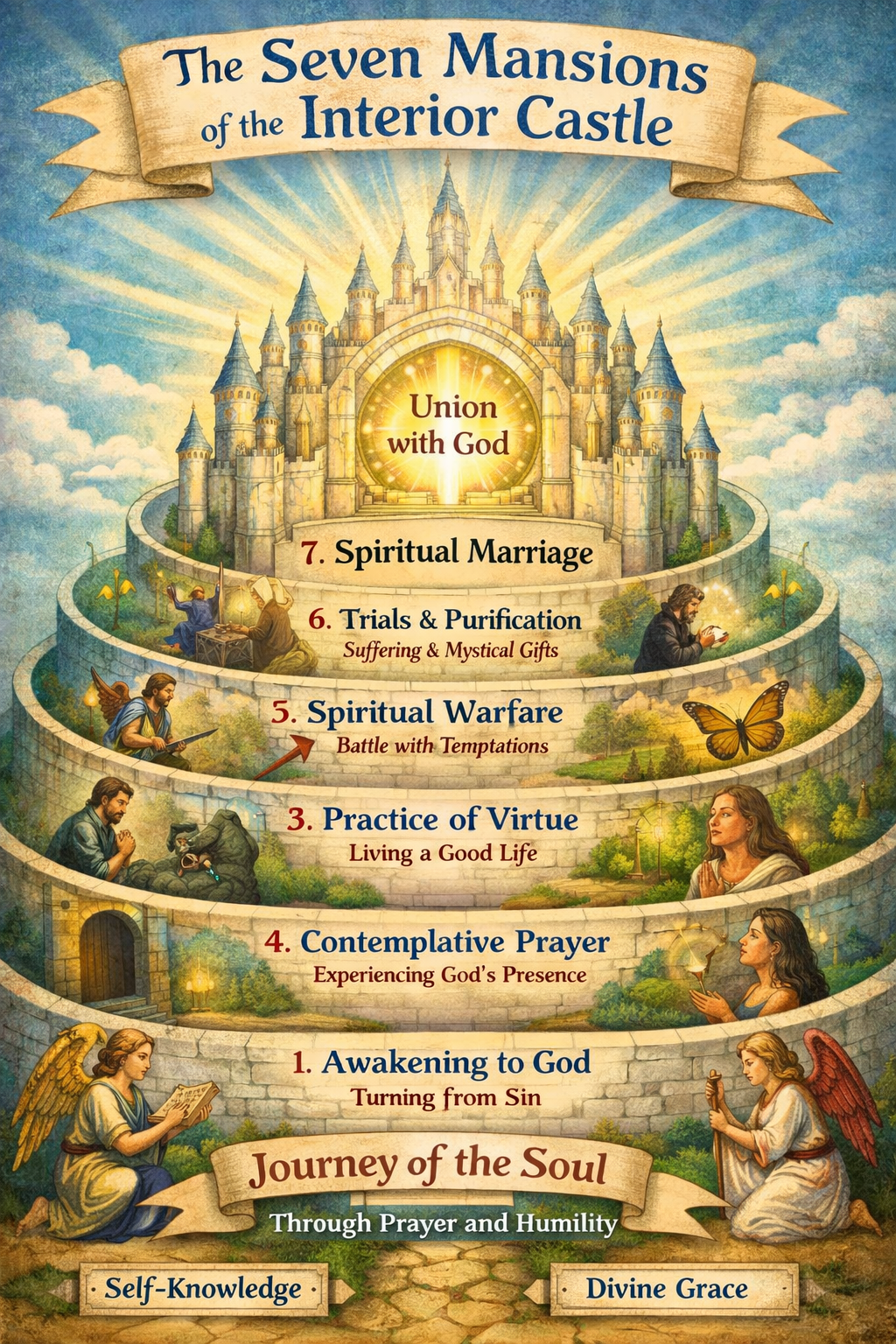
Overview of the Seven Mansions
| Mansion |
Spiritual Stage |
| 1 |
Awakening from sin |
 |
| 2 |
Beginning serious prayer |
| 3 |
Virtuous but self-reliant life |
| 4 |
Beginning contemplative prayer |
| 5 |
Prayer of Union |
| 6 |
Purification and mystical trials |
| 7 |
Spiritual marriage with God |
Summary
Saint Teresa teaches that the spiritual life is a journey inward toward the center of the soul where God dwells. Through prayer, humility, suffering, and divine grace, the soul progresses through the seven mansions until it reaches perfect union with God.
The ultimate fruit of this union is not extraordinary experiences, but deep humility, charity, and complete surrender to God's will.
"The purpose of prayer is the birth of good works."
- Saint Teresa of Avila